Category Archives: Talk
CAMOUFLAGE
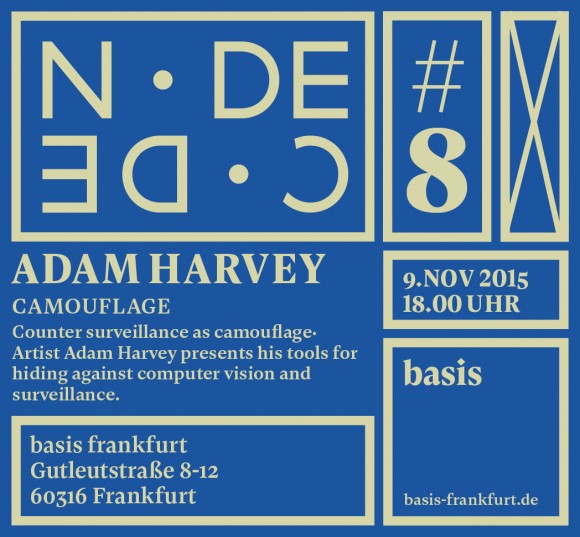
NODE+CODE #8 – Adam Harvey
9th November 2015 // Entrance: 18h / Start: 18:30
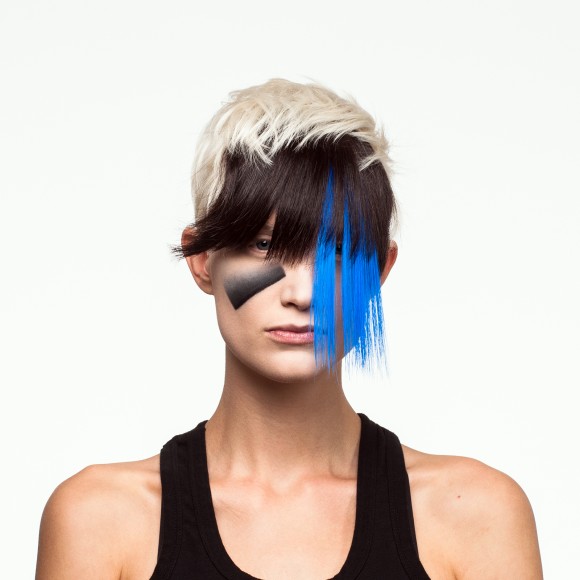
Countersurveillance as camouflage: Artist Adam Harvey will present his tools for hiding against computer vision at basis Frankfurt as our guest for the 8th edition of NODE+CODE 2015.
Adam Harvey is an artist exploring the impacts of surveillance technology on modern life. His research on countersurveillance design and art has been widely featured in media including the New York Times, Spiegel, Wired, and the Washington Post. In 2013 Harvey founded the Privacy Gift Shop an online marketplace for countersurveillance art and privacy accessories. He currently works at NEW INC, the first museum led art/tech incubator in New York City and is an adjunct professor at New York University.
NODE+CODE is an initiative by NODE – Forum for Digital Arts, supported by Stiftung Polytechnische Gesellschaft Frankfurt Am Main and the professorship for visual culture (Prof. Dr. Verena Kuni) of the Goethe-Universität Frankfurt.
———————————-
Neuer Ort und Zeit!
New location and time!
Basis Frankfurt
Gutleutstraße 8-12
60329 Frankfurt am Main
Doors open 6:00 PM / Einlass 18:00 Uhr
STARTS at 6:30 PM / Beginn 18:30 Uhr
———————————-
Free entrance / Eintritt frei!
———————————-
Supported by
Stiftung Polytechnische Gesellschaft Frankfurt am Main
———————————-
In cooperation with and ♥
basis Frankfurt am Main
———————————-
Der Veranstaltungsort ist barrierrefrei.
The location is barrier-free.
PERFORMING WITH COMPUTER VISION
NODE+CODE #7 – Max Dovey
19th October 2015 // Entrance: 18h / Start: 18:30
In the aftermath of NODE15, we continue our conversation about the role of the body in the context of technology. In discussion with artist Max Dovey, we will look into which body image is being used for classification in current image recognition technologies, their agency in the formation of ideas on the human body and how to perform with them.
Max Dovey [UK] is 28.3% man, 14.1% artist and 8.4% successful. His performances confront how computers, software and data affect the human condition. Specifically he is interested in how the meritocracy of neo-liberal ideology is embedded in technology and digital culture. He holds a BA Hons in Fine Art: Time Based Media and a MA (MDes) in Media Design from Piet Zwart Institute. His research is in liveness and real-time computation in performance and theatre. He works as a producer and creative technologist for live events and theatre in both The Netherlands and U.K.
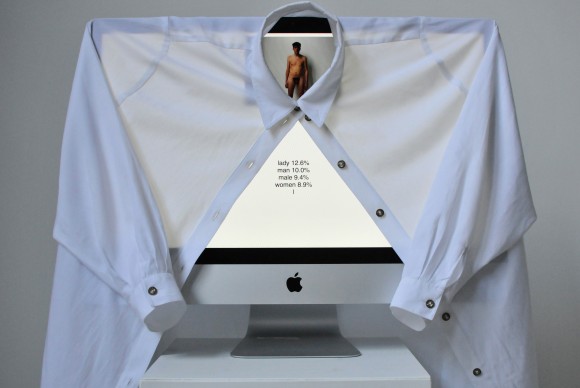
From his recently finished residency at V2, Netherlands, he sends this report about “A Hipster Bar”
http://v2.nl/archive/works/a-hipster-bar
Also here is a great interview with him:
https://www.imperica.com/en/in-conversation-with/max-dovey-beyond-the-person-beyond-the-image
Organized and moderated by Florian Jenett & Jeanne Charlotte Vogt.
———————————-
Neuer Ort und Zeit! Die Veranstaltung findet im Künstlerhaus Mousonturm statt, dem Zentrum für zeitgenössische Performance, Theater und Musik in Frankfurt (Main).
New location and time! The event will take place at Künstlerhaus Mousonturm, the center for contemporary performance, theatre and music in Frankfurt (Main).
Mousonturm
— Cafe —
Waldschmidtstraße 4
60316 Frankfurt am Main
Doors open 6 PM / Einlass 18:00 Uhr
———————————-
Free entrance / Eintritt frei!
This event on Facebook.
———————————-
NODE+CODE is an initiative by NODE Forum for Digital Arts and Processing Frankfurt, supported by Stiftung Polytechnische Gesellschaft and the professorship for visual culture (Prof. Dr. Verena Kuni) of the Goethe University Frankfurt.
———————————-
In cooperation with and <3
Mousonturm Frankfurt am Main
SAVE-the-DATE!
We are happy to be able to confirm the participation of Max Dovey, Andi Otto (Springintgut) and 3DMIN for the next NODE+CODE editions.
We will be getting back to the NODE15 research topic on the informed body and, talk about techniques of disguise in times of digital surveillance and the relation between technology and the body in music making. The artists will perform and give insights into their practice.
Venue: Künstlerhaus Mousonturm, Frankfurt
Thanks to Stiftung Polytechnische Gesellschaft
Dates to be saved for now: October 19th, November 16th!
NODE+CODE is an initiative by Processing Frankfurt and NODE Forum for Digital Arts, supported by Stiftung Polytechnische Gesellschaft and the professorship for visual culture (Prof. Dr. Verena Kuni) of the Goethe University Frankfurt.
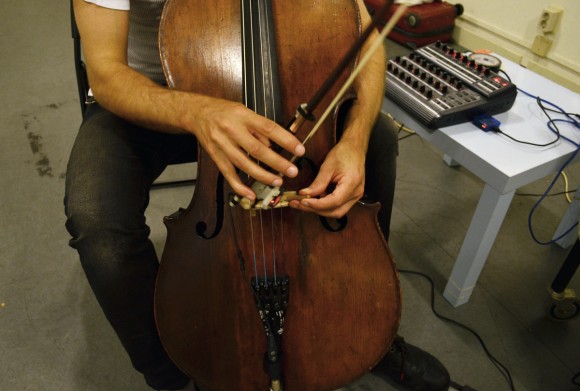
(Andi Otto & Fello, photo by Nicolo-Merendino)
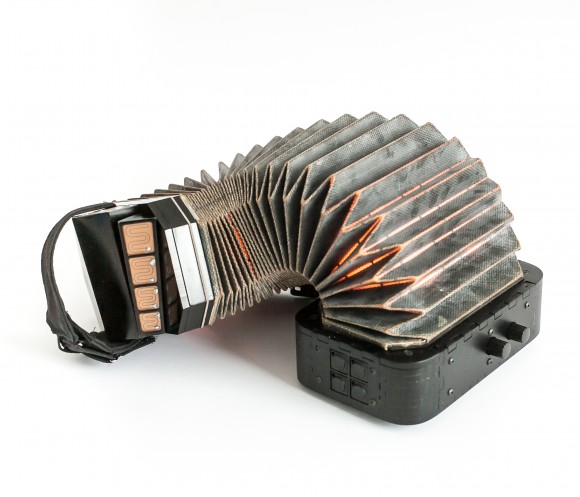
NOV13 // NODE + CODE #6 with Antoni Rayzhekov
October 29, 2014posted in: events News NODE+CODE Talk
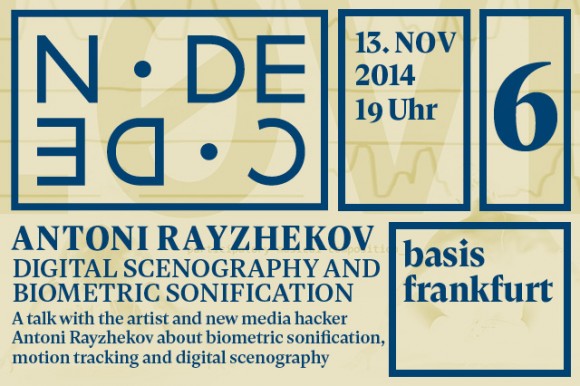
NODE+CODE Talk #6 with Antoni Rayzhekov
Digital scenography and biometric sonification
A Talk with the artist and new media hacker Antoni Rayzhekov about biometric sonification, motion tracking and digital scenography
When Thu, Nov 13th 2014 – 19:00
Where Basis Frankfurt, Gutleutstrasse 8-12, Frankfurt am Main, Germany
Admission: free
Antoni: “I want to share my experience and findings in exploring different strategies of sonification of biometric sensory data, motion tracking and audience participation in relation to digital scenography in contemporary performance context. How using cutting edge technology impacts and extends contemporary performance arts today?”
Antoni Rayzhekov is a Bulgarian theater maker, composer and new media hacker – based in Vienna, Austria. He studied theater directing and acting at the Academy for Theater and Film Arts “Krastyo Sarafov” – Sofia and jazz music improvisation – at the Vienna Konservatorium. He worked as a consultant in informational technologies for United Nations in Vienna and in the period 2008 – 2013 he established together with Emanuel Andel the vienna-based new media label THIS.PLAY – focused on interaction design. Currently he is a guest lecturer in Interactive media at the University for Applied Science – St. Pölten, Austria and independent artist.
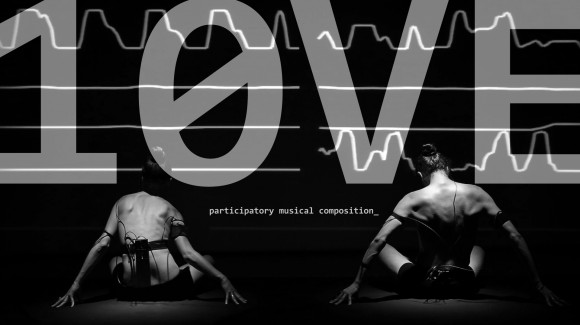
Antoni: “My work is focused on exploring synergies between generative music, contemporary performance and participatory art by designing reactive audio visual platforms that amplify different aspects of the performer and the performance itself as an attempt to communicate the invisible.”
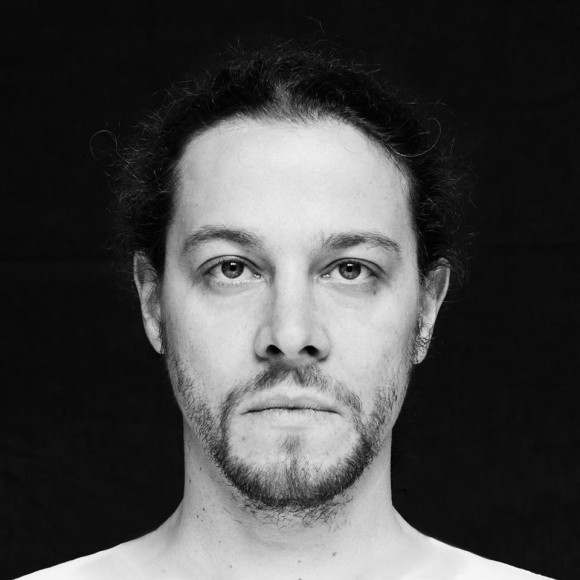
http://raijekov.cc/
http://ikpan.com/
http://this-play.com/
Free entrance, be on time and link up:
Facebook
Supported by
Stiftung Polytechnische Gesellschaft Frankfurt am Main
http://www.sptg.de/
BODY + CODE + MUSIC
A night with Alex McLean & Kate Sicchio.
When: June 5th, 2014
Where: Saasfee Pavillon, Frankfurt
What: Dance Performance, talk, live coded music
1) Performance ‘Sound Choreographer <> Body Code’
2) Talk
3) Live coded music
(feat. Alex McLean & Matthias Schneiderbanger)
“Sound Choreographer <> Body Code”
by Kate and Alex
The dance performance ist a collaboration between Live Choreography and Live Coding, creating a feedback loop where the diagrammatic choreography react and reconfigure live to music, and where the dancer represents instructions in the code, which the live coder tries to edit in order to create the music. The result is a resonance through movement, perception and language, influencing one another in a live composition, forming a whole system.
—
Alex McLean is active across the digital arts, including as one third of the live coding band slub, co-founder of the TOPLAP (http://toplap.org/) live coding movement, generative dance music promoters Algorave, and he is research fellow in human/technology interface at ICSRiM in the School of Music, University of Leeds.
Kate Sicchio works at the interface of choreography and technology. Her work includes performances, installations, web and video projects. She has presented research at many conferences and symposia and has given artist talks at places such as Times Up (Linz), The Creative Data Club (London) and the EU Commission (Brussels). Her PhD focused on the use of real-time video systems within live choreography and the conceptual framework of ‘choreotopolgy’ a way to describe this work.
http://blog.sicchio.com/?page_id=213
Matthias Schneiderbanger is an electronic musician, sonic artist and composer with min foucs on live coding, staging of electronic music, sound installations and contemporary music. He is a member of the live coding laptop ensemble Benoît and the Mandelbrots. http://www.the-mandelbrots.de/
http://matthias-schneiderbanger.de/
—
Free Entry
Presently at saasfee*pavillon:
Installations by
yacin/ruben/david
Patrick Raddatz
saasfee*
—-
Supported by
Stiftung Polytechnische Gesellschaft Frankfurt am Main
http://www.sptg.de/
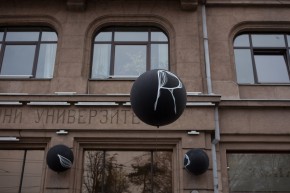
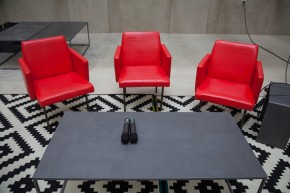
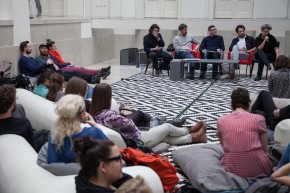
Belgrade, April 4th, 2014 – The luminous new location of Resonate2014 was the stage for the panel on choreographic coding moderated by Jeanne Charlotte Vogt and hosted by NODE. Our guests were invited to give insight into their practice at the intersection between coding and dance and to discuss challenges and potential for new approaches of collaboration.
Amongst others, we investigated the role of technology and coders in dance performance, in training and live on stage. Florian Jenett talked about his experience with choreographers who enjoyed his analytical work as inspiration for further projects but considered it a distraction from the actual work with the body. In their training, on the other hand, Christian Loclair and Raphael Hillebrand perceive improvisation tools as a support to grow beyond physical routines and standards. The panelists discussed the different routines in the two worlds and the resulting different approaches to time and working pace. The wide spread fear that technology might be perceived as an intruder and limiting factor for the dancer was responded with a call by Klaus Obermaier for understanding the generative image as a performance partner instead. The panelists agreed that for the development of future formats of collaboration these differences will need to be addressed.
At the same time, through the discussion it became clear that coding is a form of choreographic thinking. Not only the similarities between software and choreographic systems but also the similarities in mindset called for a common claim: coders should be encouraged to develop their own performative artistic language. They do have the potential to become an equal partner in the development of choreographies in the dance world.
The remaining impression of the panel was that there is a lot to talk about and far too much to cover it in a 90 minutes session.
To stay informed about next steps and opportunities for joining the discussion, visit: http://choreographiccoding.org
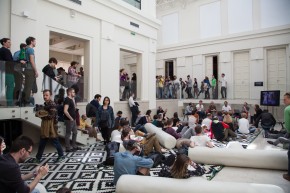
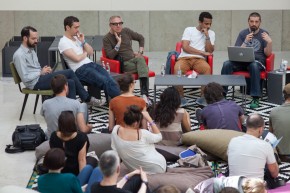
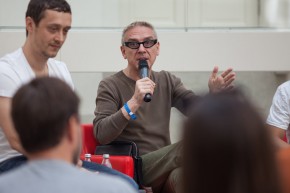
The Panel Guests
CHRISTIAN “MIO” LOCLAIR investigates collaborative media and dance mechanisms. Christian started his career as a professional dancer in 2001. His work is mainly focussing on combining media technologies and performative art. In 2005, he founded the Animatronik Project together with his mentor Niels “Storm” Robitzky. The idea behind Animatronik is to search for illusionary effects in body movements and its inner nature. He also implemented the acceleration based Popping Video Game (WiiPop) working with real physical data and the virtual improvising Funk Humanoid. At the University Potsdam he studied Computer Science, specializing in Media Engineering and Human Computer Interaction. Since 2012 he is collaborating with onformative, a studio for generative media melting art, science and design. http://princemio.net/
FLORIAN JENETT is an artist living and working in Frankfurt. His work ranges from software based art to large scale sculptural installations. Through recontextualization, manipulation and interventions he explores other possible views and meanings in rather common things.
Alongside his artistic work he has been part of the Processing team since 2005, co-founded and helps out at basis, Frankfurts largest studio house, and since 2013 is a member of NODE Forum for Digital Arts. Florian has recently been working on Motion Bank for The Forsythe Company as digital artist translating contemporary choreography into digital forms. http://florianjenett.de
KLAUS OBERMAIER was our special guest at the panel. He creates innovative works in the area of performing arts, music, theatre and new media, highly acclaimed by critics and audience.
His inter-media performances and artworks are shown at festivals and theaters throughout Europe, Asia, North and South America and Australia. He worked with dancers of the Nederlands Dans Theater, Chris Haring, Robert Tannion (DV8), Desireé Kongerød (S.O.A.P. Dance Theatre Frankfurt)… He composed for ensembles like Kronos Quartet, German Chamber Philharmonics, Art Ensemble of Chicago, Balanescu Quartet, among others.
Since 2006 he is visiting professor at the University IUAV of Venice teaching directing and new media. Also since 2006 he is jury member of the international choreography competition ‘no ballet’ in Ludwigshafen/Rhein, Germany. In 2005 and 2008 he taught as an adjunct professor for composition at the Webster University Vienna. In 2010 and 2011 he held courses for choreography and new media at the Accademia Nazionale di Danza di Roma. www.exile.at
PETER KIRN is an audiovisual artist, journalist, and technologist. He is the founder of CDM (cdm.fm /createdigitalmusic.com / createdigitalmotion.com), a leading site covering creative technology for one decade, has contributed to magazines from Popular Science to MAKE and (in a home studio feature) Men’s Health, and teaches free and open creative technology. He is also co-creator of the open source MeeBlip hardware synthesizer. A regular collaborator with dance and movement, he is a veteran of the former Dance Theater Workshop Dance and Technology residency in New York. He produces electronic music from experimental to live techno, including the duo NERKKIRN (V-Records). http://pkirn.com
RAPHAEL HILLEBRAND – Born in Hong Kong, raised in Berlin, educated through Hip-Hop Raphael Hillebrand uses his multicultural background to create his own vision of self-expression.
1997 Raphael Hillebrand began as a bboy at jams and competitions in Berlin, Germany. As a former member of 5-Amox and B-Town Allstars he won several championships such as the national Battle of the Year 2006 and the 2vs2 at the IBE in Rotterdam. Niels “Storm” Robitzky introduced him to the world of theater, at first as a dancer than as a choreographer. He combines his technique of breakin’ and poppin’ with a distinctive use of shadows and masks, which we have seen in his choreographies “Together Alone” and “Nhiều mặt„. As a member of the legendary Battle Squad and Animatronik he is an passionate member of the Hip-Hop community. www.raphael-hillebrand.com
Panel Host: Jeanne Charlotte Vogt (NODE Forum)
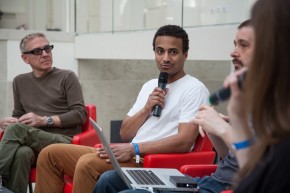
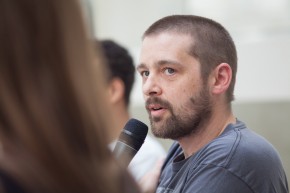
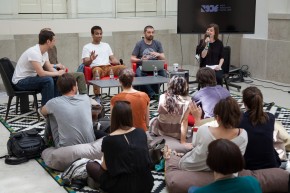
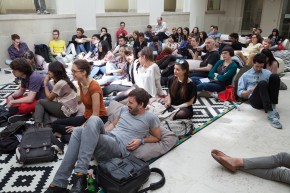
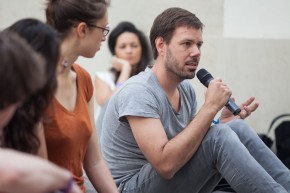
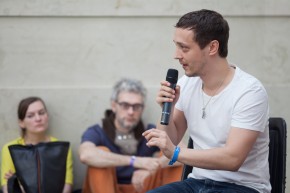
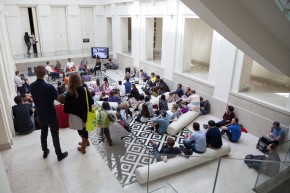
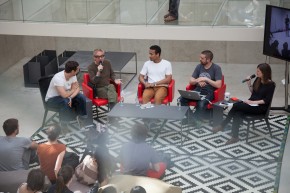
The panelists were addressing some of the key problems and questions in the collaboration between coders and dancers which will inspire upcoming Choreographic Coding Labs. To stay informed about next steps and opportunities for getting involved, visit: http://choreographiccoding.org
NODE network at Resonate…
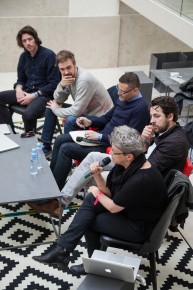
“Catalysts” Panel with
Shane Walter (onedotzero) – Chair
David Brüll (NODE Forum)
Jakob Bak/David Gauthier (CIID)
Angelique Spaninks (STRP/MU)
NODE @ Resonate 2014
April 3rd – 6th
Belgrade, Serbia
“Choreographic Coding” Panel at http://resonate.io/2014/ hosted by NODE Forum for Digital Arts.
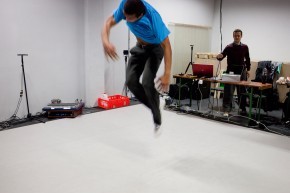
The terms choreography and coding both claim a process of creation, building a structure and authoring something in a way that can be perceived by an audience. Yet the collaboration between dancers and artists who use technology has often remained at a service-oriented level – as stage design or developing tools for improvisation.
On this panel, we want to investigate the potential for synergetic collaboration between creators, composers, or poets who use different languages – body, sound, image, or code. We want to decode the process of choreographic thinking and the question of authorship.
Florian Jenett will share his experiences with the dance world at The Motion Bank, a project of The Forsythe Company that has fueled the discourse between the dance world and digital artists, initiating large scale collaborative research. Peter Kirn will speak both from the perspective of a journalist covering performance technology and interactive design, and his own work with dancers as a composer and media artist. Choreographer Raphael Hillebrand and professional dancer and coder Christian Loclair will talk about challenges in their collaboration, and their approach to their tool Pathfinder.
.
Why should we collaborate, which formats can foster collaborative research at a visible level, and is there true meaning and impact for both coders and dancers in collaboration?
Discussants:
Raphael Hillebrand
Florian Jenett
Peter Kirn
Christian Loclair
+ Special Guest: Klaus Obermaier
Panel Host:
Jeanne Charlotte Vogt (NODE Forum)
+ Talks and Conversations by and with Florian Jenett, Eno Henze, David Brüll, Joreg and Woei.
April 24th, 2014
7pm
Basis Frankfurt, Gutleutstrasse 8-12, Frankfurt, Germany
We are entering a series of meetups that revolve around the theme of “embodiment” as it relates to technology, code, digital art and the other things we do.
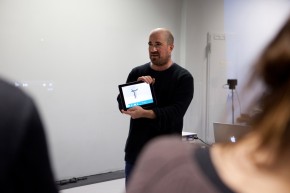
The first talk in this series is by Nick Rothwell (1), a composer, performer, software architect, programmer and sound artist. Nick is going to introduce the field framework (2) by the OpenEndedGroup (3) through a set of projects that he worked on.
Nick has a long history of projects that relate to dance and performance. He has worked with major companies in that field and on large installations. Please see his website (1) for a detailed list.
The field framework (2) has long been sort of a ghost in the area of creative coding environments. It is very unique as it is a true polyglot (Java, Python, Clojure, …) system that enables both visual and text based (live) coding.
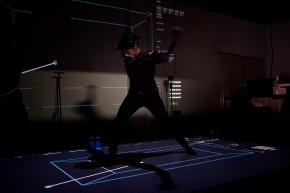
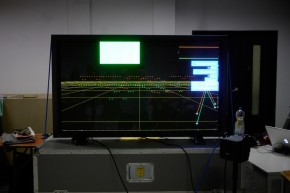
(The cover image depicts the Choreographic Language Agent tool which is part of the Becoming project (4))
—
1) http://www.cassiel.com/
2) http://openendedgroup.com/
3) http://openendedgroup.com/
4) http://www.cassiel.com/
Upcoming Workshops in the NODE Network
September 21, 2013posted in: News Talk Uncategorized Workshops
In this second half of 2013, we are focusing on deepening our connections to the international media arts scene and open the floor for new networking opportunities between international artists and creative coders. Visit us at one of the upcoming events at festivals and venues of our network:
NODE @ B3 Biennale für Bewegtes Bild, Frankfurt
October 30th-31st, 2013
Museum für Kommunikation, Frankfurt
NODE is a cooperation partner of B3 Biennale, Frankfurt, and is presenting a vvvv workshop that is approaching and exclusively making use of the Motion Bank motion capture material that will be published at the Motion Bank Live & OnLine event by the end of November.
During the NODE workshop the participants will make use of the data available on the solo piece “No Time To Fly” by Deborah Hay. The adaption of the piece by artist Amin Weber is a powerful example of the synergy being produced by the fusion of code and dance.
http://b3biennale.de/de/schedule?type=workshop#event_overlay_100
»vvvv Workshop – Von Echtzeitgrafik und expanded choreography« mit David Brüll und Woeishi Lean
For application sign in here.
NODE @ LPM – Live Performers Meeting CAPE TOWN
November 13th – 16th, 2013
Cape Town, South Africa
International exchange with our network partner LPM: For LPM Cape Town, NODE will be curating a workshop adressing the AV performer scene.
We will invite Joreg, core developer of vvvv and curator of the NODE13 workshop series, for a vvvv workshop. Join him in Cape Town!
http://2013za.liveperformersmeeting.net/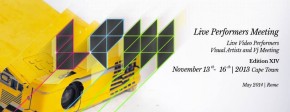
NODE @ Motion Bank Lab “Choreographic Coding”
November 26th – 29th, 2013
Frankfurt Lab, Germany
The ‘Choreographic Coding’ lab focuses on translating aspects of dance and choreography into digital form, one of the main goals of Motion Bank.
NODE will invite a range of artists to support and function as mentors for the lab participants. More Information soon here and…
… on application requirements on:
http://motionbank.org/en/event/motion-bank-laboratory
NODE @ TADAEX (3rd Tehran Annual Digital Art Exhibition)
October 4th – 16th, 2013
Mohsen Gallery, Tehran

NODE has been invited by the Goethe Institute in Tehran to join TADAEX, an exhibition and promoter of digital and media arts in Iran, that is inviting international platforms of the digital art scene such as the NODE Forum for Digital Arts to join and get in exchange with the local arts scene.
<…TADAEX focuses on art, science, technology and society to present the impact of art as a research and development tool for humanity in a variety of different disciplines. We believe that TADAEX can help to create a serious motivation for the young generation of artists in Iran to understand the influence of digital art movement.>
David Brüll, festival director and creative coder himself, will be presenting NODE, our goals and ideas as a platform for artists and other creative coders, and invite the local artist scene to join the NODE network. David is also an Open Call jury member. Additionally, a three-day vvvv beginner’s workshop will be held by Florian Egermann and David Brüll. The workshop will be followed by a showcase of the created output.
Date: October 04th – 16th, 2013
Location: Mohsen Art Gallery
No. 42, East Mina Blvd, Farzan Street, Naji Street
Zafar Tehran, Iran
vvvv introduction Workshop: October 5th – 7th
NODE presentation <bottom up coded cultures>: October 8th
vvvv workshop @ Retune Conference 2013 Berlin
September 27th, 2013
Find more Info on the workshop here: http://vvvv.org/blog/vvvv-workshop-retune-conference-2013-berlin
Date: Friday, September 27th, 2013 / 11:00 – 16:00
Location: The WYE, Skalitzer Straße 86, Berlin, Germany
Register here!
http://retune.de/2013/
Gabriel Shalom – Videomusic & Hypercubism
As part of the NODE13 Symposium in February 2013, Gabriel Shalom (founder of the design studio KS12) gave the following talk about his theories: Audiovisual composition, Video games, Dimensional collapse, Hypercubism, The transformation of the object, Speculative simulations, Design fiction, Pixels and frames, Through the looking glass.
The NODE13 Symposium was a two-day journey into discourses on The Rules of a modern, digital society through the lenses of different thinkers of our age. Not only we have been discussing these rules within panels and lectures. In advance to NODE13, we also have commissioned KS12 to develop a vision in the shape of an audiovisual essay on these transforming ‘rules’. Gabriel and his partner Patrizia came up with this video essay that has been premiered and screened as a part of the NODE13 exhibition.
Bio:
Gabriel Shalom is a director, audiovisual artist and composer living and working in Berlin, Germany. His signature work takes the form of rhythmically edited audiovisual compositions (videomusic). Taking inspiration from musique concrète, he explores the hidden musicality of everyday objects, unusual handmade electro-acoustic instruments, and manipulation of traditional instruments. He understands video to be a fundamentally audiovisual medium and strives to create highly synaesthetic works. His five channel videomusical installation The Tosso Variations premiered in his solo exhibition at MU Eindhoven. He has written and spoken extensively on Hypercubism, his theory of object-oriented aesthetics. He has been commissioned by brands such as MINI, Sony and BMW Italy. He has been an artist in residence at the ZKM Karlsruhe and the CAMP Festival in Stuttgart. He is an ADC Young Gun and a fellow of the Salzburg Global Seminar.
In addition to making audiovisual artworks, Gabriel is a director of experimental narratives. His company KS12, founded together with partner Patrizia Kommerell, is a creative studio for experimental storytelling. KS12 is the originator of the Video Sprint, a storytelling process designed for festivals and conferences. KS12 collaborates with events, agencies, and organizations, such as Transmediale, STRP Eindhoven, British Council, BOX 1824 and Meiré und Meiré. KS12 is a graduate of the Portland Incubator Experiment at Wieden + Kennedy.
Gabriel has been a guest speaker on audiovisual trends in London, Berlin and São Paulo, and since Spring 2009 he is adjunct faculty at the Berliner Technische Kunsthochschule in audiovisual media. He is a contributor to opinion-leading blogs on the future of cinema and augmented reality.