NODE + CODE MEETUPS


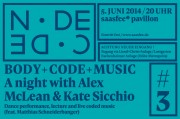
NODE+CODE is a monthly meetup in Frankfurt for artists and designers and the public with a special interest in digital media and its impact on arts and culture.
In 2014, we have entered a series of editions that revolve around the theme of “embodiment” as it relates to technology, code, digital art. Check our facebook page or meetup group to be informed about the next dates.
You can also join our special NODE+CODE and Frankfurt related newsletter!
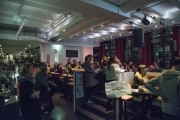
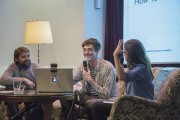
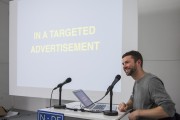
Past NODE+CODE Editions
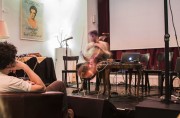
NODE+CODE #9 + #10 INSTRUMENTAL BODIES – Andi Otto & 3Dmin
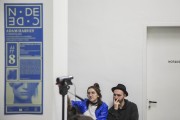
NODE+CODE #8 CAMOUFLAGE – Adam Harvey
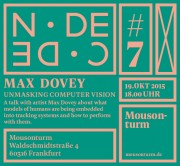
NODE+CODE #7 PERFORMING WITH COMPUTER VISION – Max Dovey
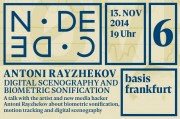
NODE+CODE #6 DIGITAL SCENOGRAPHY AND BIOMETRIC SONIFICATION – Antoni Rayzhekov
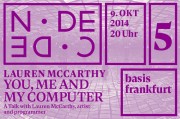
NODE+CODE #5 YOU, ME AND MY COMPUTER – Lauren McCarthy
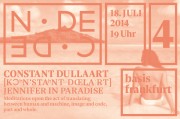
NODE+CODE #4 JENNIGER_IN_PARADISE – Constant Dullaart
NODE+CODE #3 CHOREOGRAPHY MEETS CODE – Kate Sicchio & Alex McLean
NODE+CODE #2 RECHNENDE GESCHÖPFE UND DER MENSCH DAVOR – vvvv group
NODE+CODE #1 FIELD FRAMEWORK – Nick Rothwell
––––––––––––––
In cooperation with basis Frankfurt, Künstlerhaus Mousonturm, meso digital interiors, Professur für Visuelle Kultur (Prof. Verena Kuni, an der Goethe Universität, funded by Stiftung Polytechnische Gesellschaft.
TEAM
Florian Jenett, Jeanne Charlotte Vogt, David Brüll, Alexandra Waligorski, Daniel Maaz
IMAGE
Photos: Laura Nickel / Video Documentation: Amin Weber / Graphics: Pixelgarten
SUPPORT
Thanks and <3 to: Tom Forsythe, Rosi Grillmair, MESO digital interiors and Satis & Fy.
–––––––––––––––––––––––––––––––––––––––––––––––––––––––––––––
NODE + CODE HISTORY
NODE + CODE @ DAM Gallery, Frankfurt
In July and August the regular NODE+CODE meetup was a guest of the DAM Gallery in Frankfurt. On July 30th at 7 pm we started with two contributions from the complex of relations and questions on “art and systems”. On August 27th we continued with a discussion on reverse engineering, authorship and conservation in times of digital media.
27th August 2013
On August 27th NODE + CODE virtually invited Matthew Epler, founder of the ReCode Project, for a Skype talk to DAM Gallery Frankfurt. Epler has set up a website to invite people to get to know and translate works by early digital artists like Manfred Mohr into the Processing programming language based on scans from old “Computer Graphics and Art” magazines. Any work translated there receives an open source license and can be accessed and remixed through the website.
ReCode is an attempt to spread, analyse and preserve early artistic work of digital nature – an honourly intent, if there wasn’t the complicated relationship between authorship and open access. Additionally, we discussed if reverse engineering is actually possible in this case considering that we have just one possible artifact, the one software generated plotter print. Can this be a proper reconstruction of a whole computer artwork? Together with Wolf Lieser, gallerist of DAM, we discussed the position and possible reluctance of artists whose work is recoded.
30th July 2013
Frankfurt based artists Amin Weber presented parts of his work on the Motion Bank dance research project for The Forsythe Company. Weber approached the complex choreographic system that the practice of American choreographer Deborah Hay can be understood as by adapting her solo dance piece “No Time To Fly” as 3D animation. He reported of the steps taken and how not using a human body affected the process. Further he shared what working in this way meant to him and Deborah Hay and how his adaptation fits into the overall research process itself.
In the second part of the evening, Prof. Dr. phil. Dipl. theol. Gerd Döben-Henisch introduced the “emerging mind project”. As a research project in the field of artificial intelligence it is set up as a system to produce artists along the way. To do so, environments are to be created that through tasks and interaction with the “external world” are to help minds emerge. Gerd Döben-Henisch explained the plan on how to set up this system, the interfaces it will have, and interaction it will allow. Trying to tackle two unsolved problems, namely creating an artificial mind and making computers create art, this raised quite a lot of questions that we discussed in the meeting.


PARTNERS


FUNDERS


FRIENDS & NETWORK






SUPPORTERS


© 2012. NODE - Verein zur Förderung Digitaler Kultur e.V. Legal Disclosure | Impressum